Why 1956?
1956 was the year the term Artificial Intelligence was first officially used, at a conference organised by Claude Shannon, John McCarthy, Nathaniel Rochester and Marvin Minsky.
The juxtaposition in the name ‘1956: AI Leadership Simulation™’ is deliberate. Something historic. Something cutting-edge. A name that holds the tension at the heart of this simulation: timeless human qualities, meeting the most powerful technology ever built.
In the age of AI, leaders must be bilingual
The leaders who will thrive are neither the pure technologists nor those who draw on the purely human. They are the ones who hold both with fluency and courage, equally at home in the worlds of technology and human complexity.
These claims reflect C. P. Snow’s famous lecture, The Two Cultures, delivered in Cambridge in 1959, just three years after the term Artificial Intelligence was coined. Snow lamented the growing gulf between scientific and humanities ways of thinking. That gulf has never mattered more than it does today.
Most AI learning focusses on prompting with or teaching about the technology alone. Most leadership development focusses on the human alone. 1956: AI Leadership Simulation™ integrates both, which is why it works.
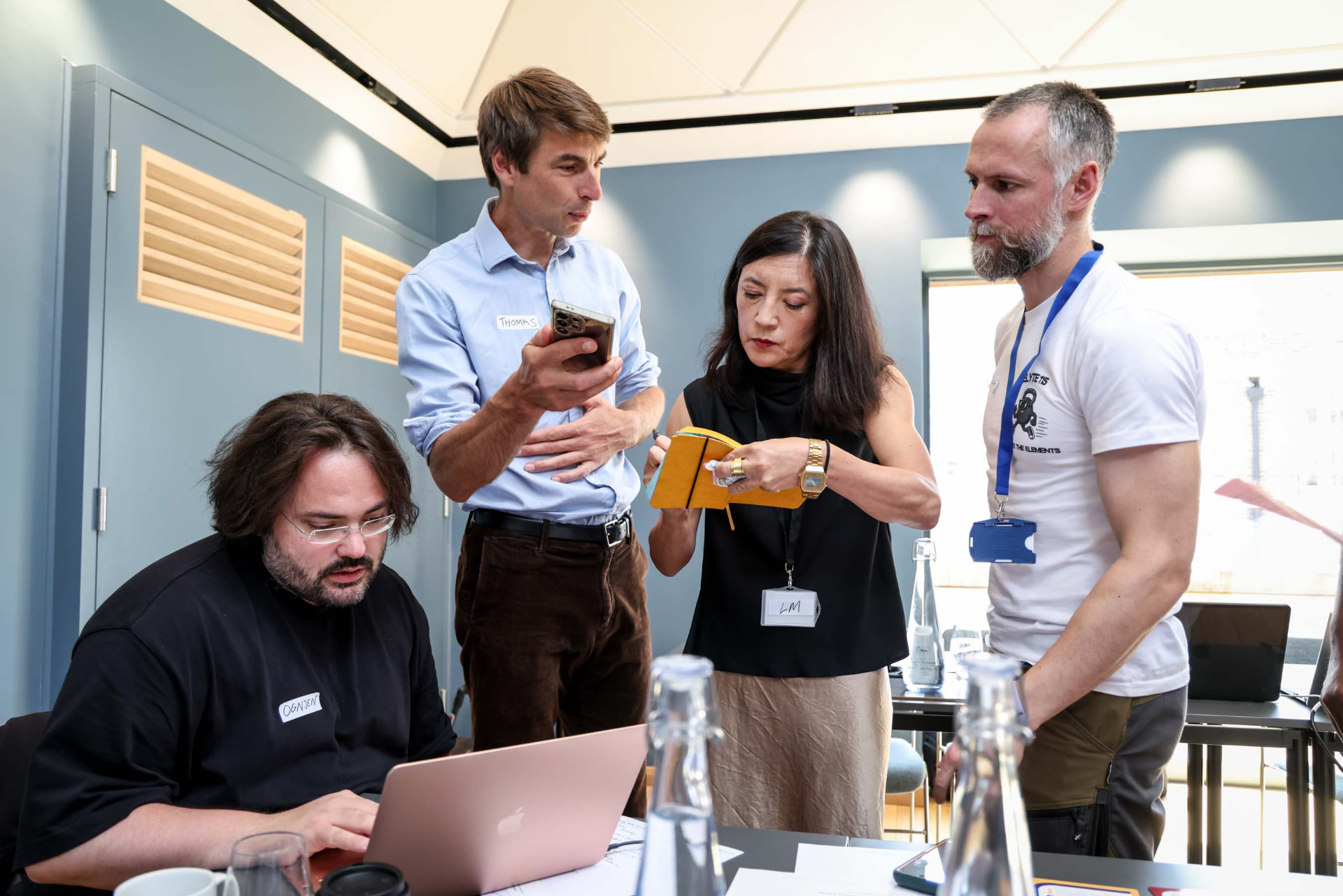
Decisions, risk and leadership, lived under pressure
The simulation begins theatrically and simply: a clear objective, a demanding customer, a deadline. Then AI and non-AI information floods in, and the sources contradict one another. What one recommendation calls a sure thing another calls a disaster; the customer asks for a certainty you do not yet possess. Cycle upon cycle, human and machine twists multiply. And slowly a quieter truth surfaces: the answer lay never in the algorithm nor human instinct alone, but in the rare art of holding both. That is the threshold which 1956 encourages participants to cross.
Two categories of learning objectives
Primarily AI-related (knowing that human leadership plays a part here)
Decision-making
Make sound decisions by integrating input from multiple AI systems while applying critical thinking and recognising when to trust versus override AI.
Why it’s hard — AI systems produce highly persuasive yet conflicting recommendations. Leaders must evaluate differing reliability levels, understand hidden system interdependencies, and retain accountability when the right answer is unclear.
Risk management
Identify and manage AI-related risks including bias, hallucinations, model drift, and overconfidence in automated outputs.
Why it’s hard — AI presents uncertainty with confidence, making flawed outputs hard to detect. Under time pressure, leaders become overly reliant on systems whose limitations may not be immediately visible.
Primarily human-related (knowing that AI plays a part here)
Leadership
Lead people effectively through the complexity and ambiguity of an AI-enabled world, while strengthening human judgement rather than defaulting decision-making to AI.
Why it’s hard — AI introduces uncertainty, pressure, and rapid change at every level. Without strong leadership, fear, confusion, and overreliance compound into misalignment, poor decisions, and team dysfunction.
Two objectives. One from each side
1956 works best when the learning objectives are precise. We hold a menu of objectives that are more granular than the above categories and that map particularly well to the simulation. Two examples:
- Judgment before tooling: learn to decide when to reach for AI at all, and which kind of AI fits the task; and learn to lead with clarity as the context turns complex, then chaotic, then complex again.
- Truth under attack: learn to detect and respond to AI-generated disinformation, deepfakes of trusted authorities included; and learn to create the conditions for a team’s finest independent thinking, where AI tempts them toward the derivative.
Each of the above pairs holds two sides, one primarily about AI, one primarily human. That pairing is where the four-hour simulation does its deepest work: leaders meet the technical demand and the human demand in the same moment, under realistic pressure.
Choosing the right objectives is much of the craft, and we do it together with you beforehand. We’re glad to talk through the fuller menu when we speak.
A proven core. Precise adjustments around it
The core of 1956 is the work of years, and we keep it as it is because it works. What we change is purposeful: the actor briefing, the roles, the number of teams, the framing of setup and debrief.
We calibrate to your cohort
Learning objectives
Together with you, we select precise objectives that map to your brief.
Actors and Head of AI probing focus
The facilitator team then focuses on the chosen objectives.
Roles and team structure
Which participant plays which role can be shaped with you ahead of the simulation experience, linked to participant profiles and objectives.
Setup and debrief framing
We can orient the setup and debrief toward your world, in a way that fits within your wider programming.
The settled core
The proprietary core is not rebuilt per client. Its integrity is what makes the learning transfer.
- The immersive narrative world
- The interplay of timeless human dynamics with modern technology
- The AI systems and their built-in imperfections
The experience comes first. Reflection follows, during and after, turning what participants have lived through into insight they can name and use. And where it helps, optional business-school-level teaching gives language to the experience and inspires further action.